By: Yuhendra
Musée du Louvre exhibited 30 Masterpieces of Islamic Art from the Metropolitan Museum of Art in New York during 04-30-2005 to 04-24-2006. Those 30 masterpiece works displayed throughout the Louvre's other galleries of Islamic art. The amazing result was people could trace and notice the change of the long history of Islamic art.
The exhibition itself was a participatory action of Islamic Art Department of The Louvre's since Metropolitan Museum of Art in New York closed for a renovation. In this part the Louvre dedicated the exhibition to the works from the excavations at Susa (south-west Iran). These selection objects were from the archaeological site at Nishapur in eastern Iran found in the late 1930s and 1940s. Nishapur produced a wealth of discoveries like decorative architectural sculpture, ceramics, bronze, glass etc. And those finds have close relation to the rest of the Islamic world, including Susa, from the 9th to the 11th centuries.
Remarkable artistic works from the Metropolitan's collection seemed to complete the Louvre’s collection in describing the period of Islamic art. People could see an exceptional dish decorated with an eagle which was famous in Egypt during 10th-11th century.There were lustrous 14 centuries tiles from the Nasrid kingdom around Granada, Spain. There was an example of medieval Iranian ceramics showing strong tie with the arts of calligraphy, book-binding etc. There were also displayed the items of metalwork, like a perfume-burner, an ink bottle which were assumed made from Iran and Egypt in 14th and 15th centuries, together with elements of architectural decoration of India in late 16th century.
 The juxtaposition of both the Louvre’s collection and the metropolitan’s ones were arranged in chronological order. Right after the entrance visitors were welcome by early works of Islamic art. There were calligraphy works on the stones and woods. Such work was a typical art of Islam in 8th – 11th century. According to the Louvre’s note, this period is the beginning of Islamic art changing. The Islamic world witnessed the rise of the caliphates of Cairo and Cordoba, while the eastern regions of Iran formed independent principalities. Freed from the constraints of antique models, the artistic canon evolves and is disseminated throughout the empire. New styles develop under the Fatimids in Spain and the eastern regions; ideas, objects, and artists move freely throughout the Islamic world, irrespective of political division (www.louvre.fr.\llv\eouvres\detail_period). Some popular works at the time were: Fragmentary Wood Panel (11th century), Cup with stylized bouquet (9th century), Stucco panel ( 9th century) and more.
Entering the new section of the exhibition would be seen the period of mid 11th to the late 13th century works. Art works is no longer expressed in wood and stones. Islamic artists tried to explore new materials. New decorative style and innovative techniques to the regions’ pottery and metalwork were found. The influence of Turks rule in Baghdad brought this innovation, while in far eastern the arrival of Mongols left the art works in more sober with rectilinear motifs. The distinguished works can be seen through; Lidded bowl made of Circa (1220), Dragon ewer (early 13th century), Stucco relief with a prince and two other figures (13th century)
The new episode of Islamic art could be seen in the next chamber displaying the dazzling items of metalwork. It demonstrate the opulence of the Mamluk court, 14th – 15th centuries which historically ruled Egypt and Syria, and maintained close contacts with the Mongols of Iran and the Christian courts of Europe. In this period, local arts root which was learn in the royal miniature-painting workshops was to become a common source of inspiration for artists throughout the Islamic world. Some works from this period are; a basin also known as the Baptistère of St. Louis (1320-40), Cup with floral decoration (1450-1500), Apothecary jar (14th century) which are most of them decorated with calligraphy.
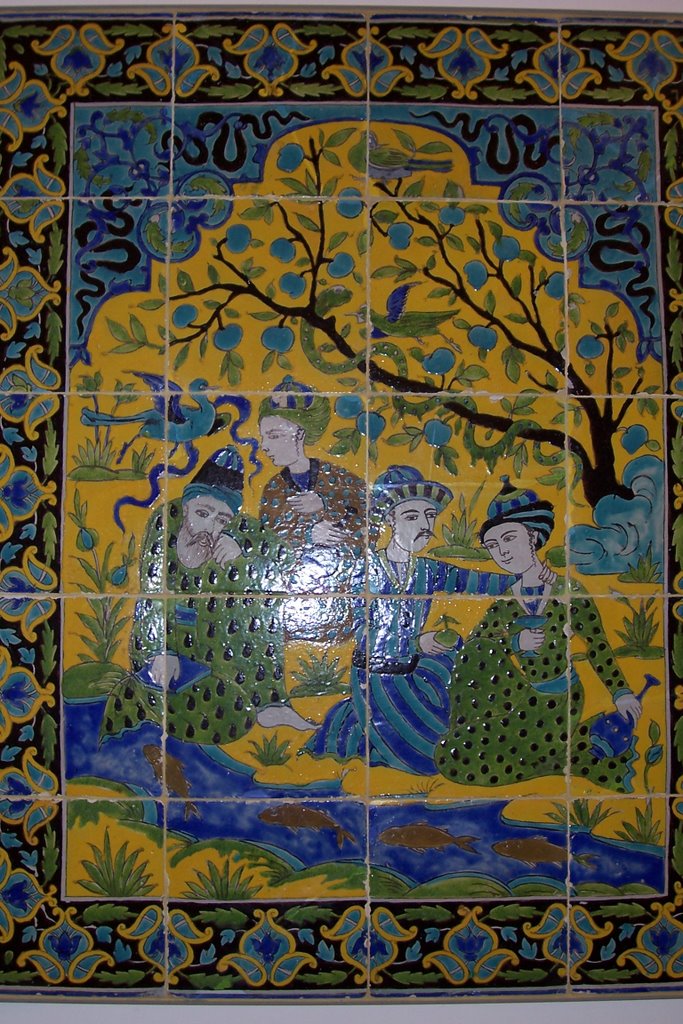
Interesting and new step of Islamic Art could be seen in the room of 16th to 19th century period. As Gombrich explains in his book The Story of Art, Looking Eastwards, in Islam the making of images was forbidden. But, in this period, Islamic Art was influence by western art. Artist started to paint images as a part of their works. Even the official rulers in this period were happy to be portrayed by artists. Take a look at the painting at the left, the painting of idyllic meeting in the garden where young people in languishing poses and idealized beauty, converse with an old man, as a symbol of wisdom and youth. There was also Portrait of Fath Ali Shah made in Circa (1805). This work shows that artists at that time also counted on commission of royal family. The portrait of the second Qajar sovereign, (1771-1834), is an example of the use of typically European easel-painting technique, which appeared in Persia in the eighteenth century. This typical Islamic works were also inspired by the famous story tale and poet like Layli va Majnoun (Layli and Majnun) Majnoun which is recognized by Layla's dog page de "Layli va Majnoun", based on a poet of Hâtifi.
Musée du Louvre exhibited 30 Masterpieces of Islamic Art from the Metropolitan Museum of Art in New York during 04-30-2005 to 04-24-2006. Those 30 masterpiece works displayed throughout the Louvre's other galleries of Islamic art. The amazing result was people could trace and notice the change of the long history of Islamic art.
The exhibition itself was a participatory action of Islamic Art Department of The Louvre's since Metropolitan Museum of Art in New York closed for a renovation. In this part the Louvre dedicated the exhibition to the works from the excavations at Susa (south-west Iran). These selection objects were from the archaeological site at Nishapur in eastern Iran found in the late 1930s and 1940s. Nishapur produced a wealth of discoveries like decorative architectural sculpture, ceramics, bronze, glass etc. And those finds have close relation to the rest of the Islamic world, including Susa, from the 9th to the 11th centuries.
Remarkable artistic works from the Metropolitan's collection seemed to complete the Louvre’s collection in describing the period of Islamic art. People could see an exceptional dish decorated with an eagle which was famous in Egypt during 10th-11th century.There were lustrous 14 centuries tiles from the Nasrid kingdom around Granada, Spain. There was an example of medieval Iranian ceramics showing strong tie with the arts of calligraphy, book-binding etc. There were also displayed the items of metalwork, like a perfume-burner, an ink bottle which were assumed made from Iran and Egypt in 14th and 15th centuries, together with elements of architectural decoration of India in late 16th century.
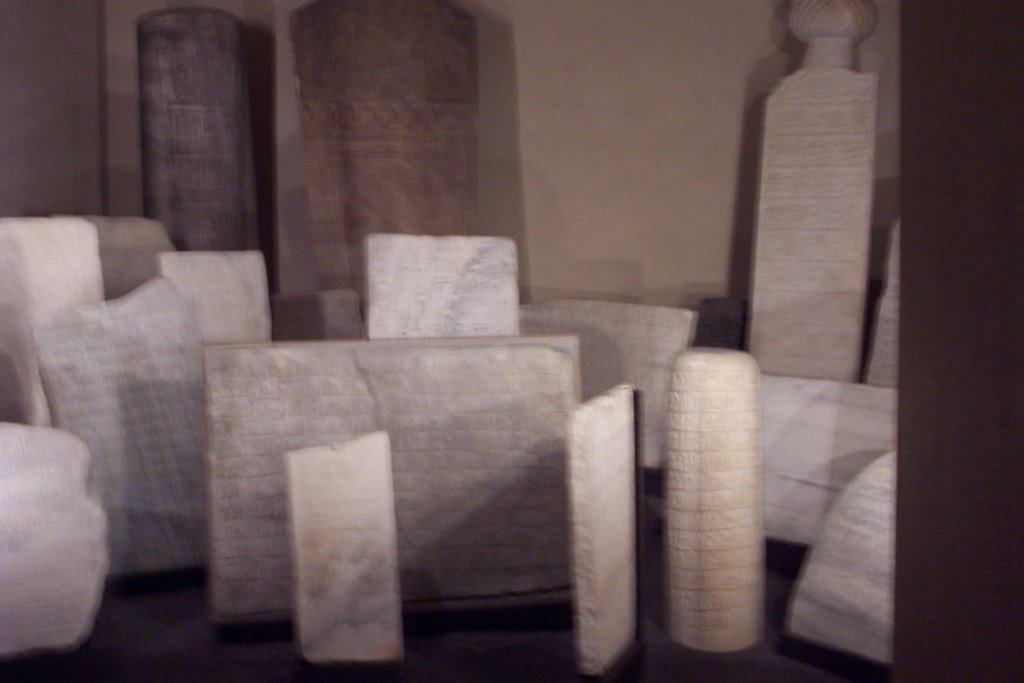 The juxtaposition of both the Louvre’s collection and the metropolitan’s ones were arranged in chronological order. Right after the entrance visitors were welcome by early works of Islamic art. There were calligraphy works on the stones and woods. Such work was a typical art of Islam in 8th – 11th century. According to the Louvre’s note, this period is the beginning of Islamic art changing. The Islamic world witnessed the rise of the caliphates of Cairo and Cordoba, while the eastern regions of Iran formed independent principalities. Freed from the constraints of antique models, the artistic canon evolves and is disseminated throughout the empire. New styles develop under the Fatimids in Spain and the eastern regions; ideas, objects, and artists move freely throughout the Islamic world, irrespective of political division (www.louvre.fr.\llv\eouvres\detail_period). Some popular works at the time were: Fragmentary Wood Panel (11th century), Cup with stylized bouquet (9th century), Stucco panel ( 9th century) and more.
Entering the new section of the exhibition would be seen the period of mid 11th to the late 13th century works. Art works is no longer expressed in wood and stones. Islamic artists tried to explore new materials. New decorative style and innovative techniques to the regions’ pottery and metalwork were found. The influence of Turks rule in Baghdad brought this innovation, while in far eastern the arrival of Mongols left the art works in more sober with rectilinear motifs. The distinguished works can be seen through; Lidded bowl made of Circa (1220), Dragon ewer (early 13th century), Stucco relief with a prince and two other figures (13th century)
The new episode of Islamic art could be seen in the next chamber displaying the dazzling items of metalwork. It demonstrate the opulence of the Mamluk court, 14th – 15th centuries which historically ruled Egypt and Syria, and maintained close contacts with the Mongols of Iran and the Christian courts of Europe. In this period, local arts root which was learn in the royal miniature-painting workshops was to become a common source of inspiration for artists throughout the Islamic world. Some works from this period are; a basin also known as the Baptistère of St. Louis (1320-40), Cup with floral decoration (1450-1500), Apothecary jar (14th century) which are most of them decorated with calligraphy.
Interesting and new step of Islamic Art could be seen in the room of 16th to 19th century period. As Gombrich explains in his book The Story of Art, Looking Eastwards, in Islam the making of images was forbidden. But, in this period, Islamic Art was influence by western art. Artist started to paint images as a part of their works. Even the official rulers in this period were happy to be portrayed by artists. Take a look at the painting at the left, the painting of idyllic meeting in the garden where young people in languishing poses and idealized beauty, converse with an old man, as a symbol of wisdom and youth. There was also Portrait of Fath Ali Shah made in Circa (1805). This work shows that artists at that time also counted on commission of royal family. The portrait of the second Qajar sovereign, (1771-1834), is an example of the use of typically European easel-painting technique, which appeared in Persia in the eighteenth century. This typical Islamic works were also inspired by the famous story tale and poet like Layli va Majnoun (Layli and Majnun) Majnoun which is recognized by Layla's dog page de "Layli va Majnoun", based on a poet of Hâtifi.
Some artists also made controversial works like a painting of Adam and the angels. This painting would seem as an illustration of Ishaq Nishapuri's Stories which the basic source was the Koran. In that painting, Adam was seated on a throne, an aura of fires around his head marking his status as a prophet, receives the homage of all the angels. Or the most divisive one, the painting of The angel Gabriel reveals the eighth surah of the Qur'an to Muhammad Siyar-i Nabi (Life of the Prophet")made around 1595. As the matter of fact, making a picture of prophet Muhammad is forbidden. But the artist found a solution by covering Prophet Muhammad’s face by a veil. This page is from a "Life of the Prophet" in six volumes, ordered by the Ottoman sultan Murad III (1574-1595) from the calligrapher Mustafa ibn Vali. It was created in the naqqashkhana (imperial workshop) led by the painter Lutfi 'Abdullah. The complete work contained 814 minatures. This one depicts a key episode in the revelation of Islam: the divine messenger Gabriel places in the hands of the prophet Muhammad a page on which is written the 41st verse of the seventh surah of the Qur'an (www.louvre.fr.\llv\eouvres\detail_notice).
The exhibition showed vividly the steps of Islamic arts. It is understood that, art is developing and even the western art was also adopted by Moslems artists. Those works are remarkable and have historical values.
Photos; yuhendra

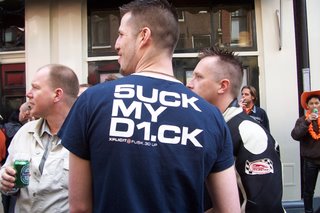
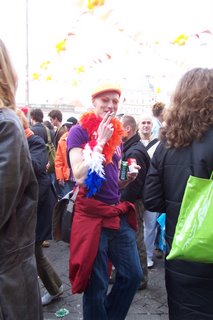 In attire few people of that minority group were also distinguishing. They were so dare to wear unusual clothing that people would stare and take a look at them and understand they were queers. It would be obvious if there are three guys, one of them in tight t-shirt with big capital letter written “SUCK MY DICK” at the back kissing his friends' ears. A guy wearing a fur with rouge lipstick color and long orange artificial eyelids merely cheered the gangs. Or a man in his late thirties was dressed up in a monarchial queen style plus a queen-make-up look, unsuccessfully hiding he was a queer.