Translate

Showing posts with label Global Trip. Show all posts

Friday, August 24, 2007

Strolling around Malmö’s Parks


It is a cloudy afternoon after a light rain in Malmö. On this day spring temperatures show 16º C. After hiding from pouring water in their houses or finishing their work in offices, people start going out. Some men and women can be seen taking their dogs out strolling around the park. Couples are sitting on the benches flirting with one another. Kids are running on a green yard though it is still not completely dry.

It is a common view in Malmö. What was Viking region in the past, at present has impressive parks. The parks are the background of gothic style buildings and modern ones. The parks give quietness and even an opportunity to escape from the city crowd. Malmö has many impressive parks to welcome the people to the “City of Parks”.

Due to their beauty, Malmö’s parks becomes valuable credit the city tourism sector and provide places for public meetings. Strolling around the parks inhaling fresh air, lying on the grass listening to the birds singing, sitting on benches watching ducks and geese floating on the ponds make unforgettable experience. It will make us feel sorry to leave Malmö without having visited at least one of the parks.

There are three exquisite and famous parks in Malmö: Slottsparken (The Castle Park), Kungsparken (The King´s Park) and Pildammarna (The Willow Ponds). These greens are easily found and only take a five-to- fifteen minute walk from the city centre. In Slottsparken you will see a modern city park with water as its main motif. Big stretch of wood, astonishing views and park benches distinguish this park. A five-minute walk from city centre, you will find Kungsparken which lies right in the heart of Malmö. It has plenty of shadow with a number of various trees. And only a fifteen-minute strolls away from Kungsparken, we can see Pildammsparken the biggest, classiest park in Malmö. Here, more than 10.000 flowers are planted in the "flower-alley" once in a year.

To create the image of the “City of Parks”, Malmö has its own strategy. It is not an instant project, but popular gardeners have been enlisted to decorate parks and gardens. Creating cosy parks becomes a continuous program, which has the whole community involved and makes them respect the environment.

“We have a two-day annual program held in squares for kids when they experience gardening. They are taught how to plant and to maintain the plantation,” says Magnus Hammer, from Malmö Community Technique. Parents take their kindergarten students to the squares. This year the event takes place in Värnhem Square, where they are told plants and animal fables before planting the seeds. Indeed such programs named Flowers Day make both the parks more beautiful and people enjoy the park festivity.

Regarding the community care, wandering around other small parks like: Raoul Wallenbergs Park, Ribersborg and Scania-park, Bulltofta Park, Bunkeflo ängar and many more becomes soothing. They are clean and well-designed with a great variably of plants. No wonder, parks which is also place for old cemeteries where old inhabitants have been laid in are not scary to camp in.

Seeing Malmö Through The Outsiders’ Spectacles


Malmö is positioning itself to be an international city. People are coming there to study, to make a living, to do business and for leisure. The immigrants and city developments benefit each other and make the city colored.

“Malmö is a really great place to study. Whatever students need is available and accesses for education facilities are easily got,” says Wisnu, an Indonesian student of World Maritime University in Malmö.

Studying in Malmö is fortunate for the 28-year-old man, as he didn’t have such favorable experiences studying in his home country. In this northern city in Sweden he gets email access 24 hours a day, a complete library, democratic class atmosphere that makes students are free to argue even with their teachers, student card for free city transportation, comfortable condition for studying and many more exciting reasons. Students find living in this city is very comfortable.

“Here is the place where people live with respect for one another. We discover the beauty of ancient Europe through the buildings and landscape. People obey rules and facilities are sophisticated. One more thing, even as a student we feel honored for once in a year the major of this city himself treats us to a special dinner as a welcoming greeting. This is really new for me because in my hometown a major don’t hold a dinner party for students nor even international students,” says Sidi, a student from Kenya.

What Wisnu and other foreign students see and feel indicate that while Malmö was once known as an industrial city, it now has a brand new image as a knowledge city . But Malmö is also a city where 25 percent of the population was born in a foreign country. . Those immigrants bring color to Malmö.

“I have been living here more than 23 years. I cannot say this is the nicest place in Europe. I have to say that living here is too calm and steady. Besides living here is not easy because it is hard to earn a living here. If you want to have a job you must register to employment agency, of which the process takes long time and most of the time you will be rejected because of your poor appearance. Indeed government gives homeless people donation but that is not enough to decrease homelessness number on the street,” says Bianca, 65, a Poland-born. .

Very much different opinion from her, Harry, 27, British man, finds Malmö a nice place to live. The rules and the calmness make Malmö special. For young people like him the city provides; entertainment like leisure time in the cafés around Gustav Adolf’s Torg or Folkets Park, going to cinemas to watch the latest movies, gathering with pals in Laserdome, Bryggeriet/Skateboard arena.

“Of course I cannot compare this city to London. But anyhow, this city is wonderful place to live and it is making its own to be a developed one,” Harry, who works as a restaurant waiter to earn his living in Malmö adds.
Malmö is making steps to be an international city. According to official statistics, immigrants from Yugoslavia first with approximately 10,000 people, Iraqis with more than 6000 immigrants and others from Denmark, German, Lebanon and few numbers from Asian countries. The local government can attract more international people to visit and invest their business here by using the existence of these multicultural settlers. They want to show that Malmö is welcoming people over the world.

Feel the Winds of Change in Malmö, Sweden

WeLL...
One year after all. And I don't post anything new so far. It was just my friend's blog ringing my head that i need to post something. At least I still got two more articles from my trip to Malmö, Sweden. Here they are...


Significant changes have taken place in Malmö during the past century. In the early 1900s the city started developed and turned out to be an important industrial center. Since the collapse of heavy industry in Malmö in the early 1990s, the city focused more and more towards knowledge and service, leaving most of the past industrial heritage. Now, instead of seeing big factories in town it is easier to find fancy corners for having fun.

Malmo’s size and strategic location make the third largest city in Sweden the commercial centre of the south of the country. With approximately 270,000 residents who speak hundreds of languages and come from hundreds of various nationalities, Malmö is a city moving to be an international metropolis. But to achieve the goal, turning the past image from industrial into new brand city was not a peace of cake. Definitely it was not as easy as creating Turning Torso-a spectacular apartment in the Western Harbor, which was built within four years since constructed in 2001. Malmö is managing strategies to fulfill its future vision and give people a chance to feel the change or be part of it.

Malmö is in transition. She is creating new images that show that Malmö doesn’t want to be simply a pop-in city from its neighbors. Whatever the image will be in the future, the city is actively creating an attractive and dynamic environment, for tourism, people and business.

Malmö in History
Malmö is a dynamic city. Its long historical record and past experience as industrial city has the city well prepared for global changes. In 1000-1300 Viking merchants and warriors lifted their anchors from this area to sail to England, Iceland and all the way to the Middle East. Three centuries later, Malmö grew to become an essential commercial heart ruled by three countries: Sweden, Denmark and the Hanseatic League, exporting barrels of local salt herring.

Malmö has been part of the Swedish region since 1658, after Denmark declared war against Sweden. To improve commercial profits and make the town flourish, the harbor was rebuilt over one hundred years. The following hundred years, Malmö turned into an important industrial city in Europe. But, the oil crisis caused severe problems for heavy industry from 1973 to 1974. The city was forced to find new ways to rock it back. Immigrants were welcomed, town was beautified for tourism and big investments in educations sector were made to help the city become a scientific city and service center. Malmö is ready to say “good-bye” to an industrial heritage.

Malmö at Present
Now in the new millennium, government effort to succeed the building of mega construction Turning Torso, Öresund Bridge that joins Malmö and Copenhagen become outstanding proof of the city awakening. The city is also developing infrastructures to make it very easy to reach by plane, train or car. Copenhagen and Malmö airports are only half an hour’s trip from the center of the city. Good access to the motorway will let people arrive at the city center as easy as if going to the rest of Sweden and Europe. Those examples are just preliminary projects for bigger ones.

There are new ambitious projects to strengthen Malmö position among other European cities. Multiarena and the shopping mall will be inaugurated in 2008. Its modern design eases visitors from Copenhagen to spend their money there as the Malmö-Copenhagen Metro station will stops just outside the doors. There will also be Hyllie- a futuristic place to live, work and be entertained, strengthening “the new” Malmö as a fun city. This location will be a kind of small village where people are not necessary to gout since what they need is available in it.

Tourism Develops
Tourism is one of the profitable sectors Malmö increase. Basically from a tourist’s point of view, this past Viking region has a lot to offer the sightseers. The location is strategic and close to Copenhagen, Denmark which is now connected by a new bridge called Öresundsbron. Seeing Malmö from period to period will be easy just by seeing its wondrous buildings. Take the oldest building, St. Petri Kyrka Church with “Brick Gothic” style for instance. It represents the glorious 14th century and stands out from behind the City Hall. To see the stylistic ideals of the renaissance period, Malmöhus Castle surrounded by moat is a suitable monument to visit. The Commandant’s House is also a proper place to see the reflection of Sweden’s neutrality during world wars. This house used to be a hospital, barracks and emergency housing during the First and the Second World War. A step ahead in the millennium era, the tallest building- Turning Torso, symbolizes Malmö’s sensitivity in anticipating global competition and modernizing the city look. To preserve the Scandinavian atmosphere, brick-ancient houses are carefully kept and renovated for apartments and shops.

In addition, Malmö also has other various places worth visiting like the squares Gustav Adolf’s Torg, Lilla Torg to hang around, Folkets Park for kids and family activities, Slottsmölllan and Slottsträdgården for sightseeing. To shop until you drop in the main shopping district around Gustav Adolf’s Torg or to have coffee-break in open cafes around public centers could gives an unforgettable experience during your stay in Malmö. Museums, playgrounds and well-designed parks are available. Even for wandering and jogging, cemeteries are no longer scary since they are decorated with artistic statues, planted with various flowers and trees and completed with benches to enjoy free-time sitting. To gain more tourists Malmö has not only completed infrastructures but also planned and held annual events for upcoming years such as exhibitions, operas and drama performance in theaters.

But in the name of tourism, do not expect Malmö to be like Paris, crowded by young people taking part in the city by performing, painting, playing music, or selling typical merchandise from the city. Do not even expect Malmö to be as liberal as cities in Netherlands that provide a red light district area for prostitution. By law, men will be sued for paying prostitutes (only if they exist).

Malmö is just Malmö. This Scandinavian city is trying to hit big impression for tourism identity, no matter at presents tourists who come there simply for popping in for hours or a day from Copenhagen.

“We have agenda and events for tourists. Despite what we offer and we have, tourists coming here only those coming from Copenhagen for one or two days or even for hours,” said Jessica, a staff member with Tourist Information.

Immigrants Come
To make other steps to be an international city, just like other European cities, Malmö also welcomes immigrants; most of them asylum-seekers. In Malmö the types of immigrants are mixed. There are foreign-born from Iraq, Poland, Bosnia, Lebanon, Iran, Hungary, Germany and yet others from Asia. Based on 2005 statistics, the number of foreign-born persons is 25 percent while foreign citizens make 10 percent of the total number of Malmö community.

“When I came here in 1992 I met only blonde people, but five years after I started meeting people with different skin color. This city is not just developing in the sense of the economy but also in number of inhabitants,” said Carmen an American-born who is now has Sweden nationality and working as a caretaker at World Maritime University Student Hostel.

Undoubtedly, the existence of immigrants gives color to Malmö. Their presence in the city contributes global nuances. It is easy to meet veiled, Middle Eastern women in the bus, talk to colored young people while sitting in the park, and see narrow-eyed Chinese teenagers shopping in malls or smell strong food from Asian restaurants. No wonder, souvenirs from Malmö are not only postcards with interesting tourism spots in the city but also Indian sari, miniatures of sphinxes from Egypt, carpets from the Middle East, or the head of a Buddha statue from China.

Business
In addition, business is also a main sector which is encouraged in Malmö. Since heavy industry has long passed away, Malmö has expanded retail and wholesale trade, logistics, construction and property sector. And now, there are many well-known companies running their businesses here within biotechnology and medical technology, IT and digital media. Furthermore, Malmö include scientist and academician to take part in that sector. To give a good result, cooperation between colleges, science parks and companies is a beginning for entrepreneurs and creative development in Malmö before starting the business.

Knowledge
Creating an image of multicultural, business and tourism city seems not enough for Malmö. Above all, that municipality is creating a new image as the city of knowledge, by improving its look and providing educational infrastructures. Previous manufacturing has been replaced by investment in sophisticated technology and training programs. Completing the effort, in 1998 Malmö University was launched accommodating 15,000 students.

Wednesday, May 17, 2006

Tracing Islamic Art in Musée du Louvre

By: Yuhendra

Musée du Louvre exhibited 30 Masterpieces of Islamic Art from the Metropolitan Museum of Art in New York during 04-30-2005 to 04-24-2006. Those 30 masterpiece works displayed throughout the Louvre's other galleries of Islamic art. The amazing result was people could trace and notice the change of the long history of Islamic art.

The exhibition itself was a participatory action of Islamic Art Department of The Louvre's since Metropolitan Museum of Art in New York closed for a renovation. In this part the Louvre dedicated the exhibition to the works from the excavations at Susa (south-west Iran). These selection objects were from the archaeological site at Nishapur in eastern Iran found in the late 1930s and 1940s. Nishapur produced a wealth of discoveries like decorative architectural sculpture, ceramics, bronze, glass etc. And those finds have close relation to the rest of the Islamic world, including Susa, from the 9th to the 11th centuries.

Remarkable artistic works from the Metropolitan's collection seemed to complete the Louvre’s collection in describing the period of Islamic art. People could see an exceptional dish decorated with an eagle which was famous in Egypt during 10th-11th century.There were lustrous 14 centuries tiles from the Nasrid kingdom around Granada, Spain. There was an example of medieval Iranian ceramics showing strong tie with the arts of calligraphy, book-binding etc. There were also displayed the items of metalwork, like a perfume-burner, an ink bottle which were assumed made from Iran and Egypt in 14th and 15th centuries, together with elements of architectural decoration of India in late 16th century.

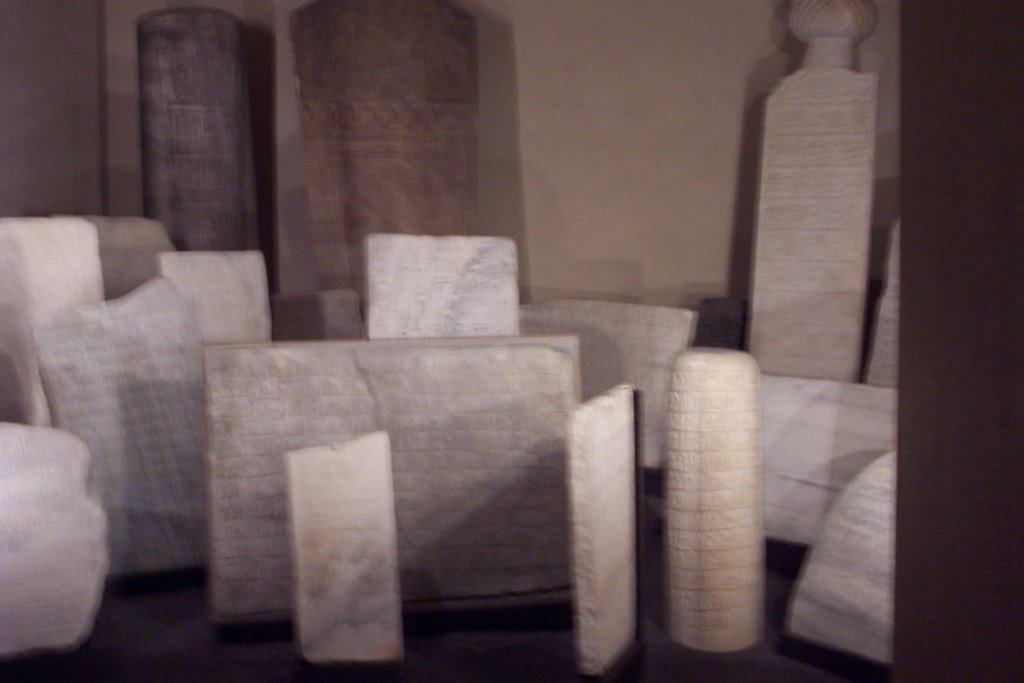
The juxtaposition of both the Louvre’s collection and the metropolitan’s ones were arranged in chronological order. Right after the entrance visitors were welcome by early works of Islamic art. There were calligraphy works on the stones and woods. Such work was a typical art of Islam in 8th – 11th century. According to the Louvre’s note, this period is the beginning of Islamic art changing. The Islamic world witnessed the rise of the caliphates of Cairo and Cordoba, while the eastern regions of Iran formed independent principalities. Freed from the constraints of antique models, the artistic canon evolves and is disseminated throughout the empire. New styles develop under the Fatimids in Spain and the eastern regions; ideas, objects, and artists move freely throughout the Islamic world, irrespective of political division
(www.louvre.fr.\llv\eouvres\detail_period). Some popular works at the time were: Fragmentary Wood Panel (11th century), Cup with stylized bouquet (9th century), Stucco panel ( 9th century) and more.

Entering the new section of the exhibition would be seen the period of mid 11th to the late 13th century works. Art works is no longer expressed in wood and stones. Islamic artists tried to explore new materials. New decorative style and innovative techniques to the regions’ pottery and metalwork were found. The influence of Turks rule in Baghdad brought this innovation, while in far eastern the arrival of Mongols left the art works in more sober with rectilinear motifs. The distinguished works can be seen through; Lidded bowl made of Circa (1220), Dragon ewer (early 13th century), Stucco relief with a prince and two other figures (13th century)

The new episode of Islamic art could be seen in the next chamber displaying the dazzling items of metalwork. It demonstrate the opulence of the Mamluk court, 14th – 15th centuries which historically ruled Egypt and Syria, and maintained close contacts with the Mongols of Iran and the Christian courts of Europe. In this period, local arts root which was learn in the royal miniature-painting workshops was to become a common source of inspiration for artists throughout the Islamic world. Some works from this period are; a basin also known as the Baptistère of St. Louis (1320-40), Cup with floral decoration (1450-1500), Apothecary jar (14th century) which are most of them decorated with calligraphy.

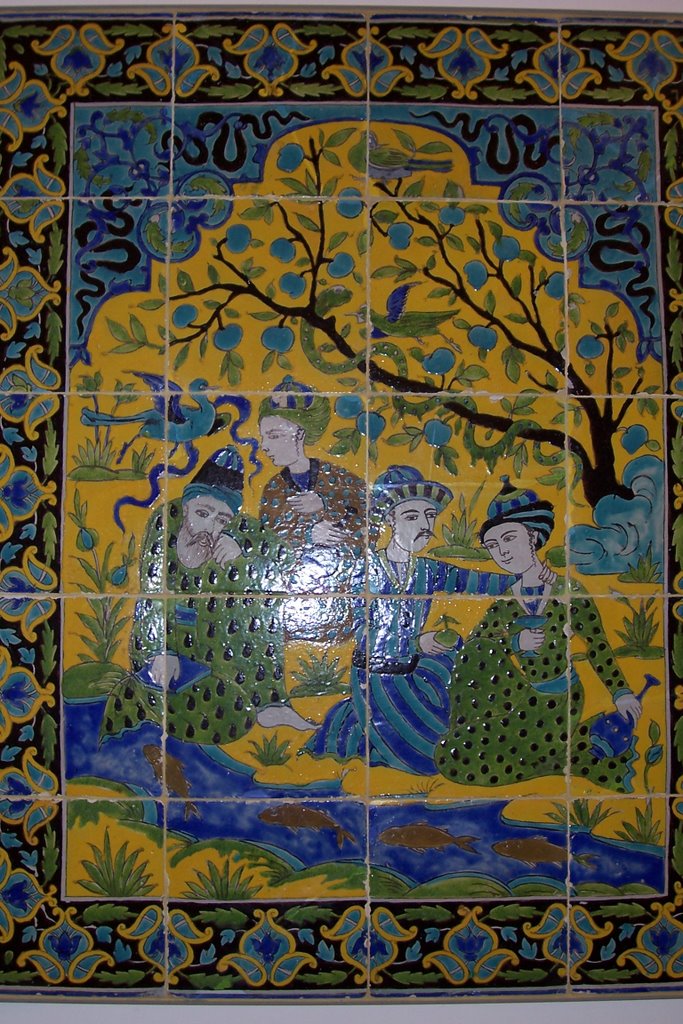
Interesting and new step of Islamic Art could be seen in the room of 16th to 19th century period. As Gombrich explains in his book The Story of Art, Looking Eastwards, in Islam the making of images was forbidden. But, in this period, Islamic Art was influence by western art. Artist started to paint images as a part of their works. Even the official rulers in this period were happy to be portrayed by artists. Take a look at the painting at the left, the painting of idyllic meeting in the garden where young people in languishing poses and idealized beauty, converse with an old man, as a symbol of wisdom and youth. There was also Portrait of Fath Ali Shah made in Circa (1805). This work shows that artists at that time also counted on commission of royal family. The portrait of the second Qajar sovereign, (1771-1834), is an example of the use of typically European easel-painting technique, which appeared in Persia in the eighteenth century. This typical Islamic works were also inspired by the famous story tale and poet like Layli va Majnoun (Layli and Majnun) Majnoun which is recognized by Layla's dog page de "Layli va Majnoun", based on a poet of Hâtifi.
Some artists also made controversial works like a painting of Adam and the angels. This painting would seem as an illustration of Ishaq Nishapuri's Stories which the basic source was the Koran. In that painting, Adam was seated on a throne, an aura of fires around his head marking his status as a prophet, receives the homage of all the angels. Or the most divisive one, the painting of The angel Gabriel reveals the eighth surah of the Qur'an to Muhammad Siyar-i Nabi (Life of the Prophet")made around 1595. As the matter of fact, making a picture of prophet Muhammad is forbidden. But the artist found a solution by covering Prophet Muhammad’s face by a veil. This page is from a "Life of the Prophet" in six volumes, ordered by the Ottoman sultan Murad III (1574-1595) from the calligrapher Mustafa ibn Vali. It was created in the naqqashkhana (imperial workshop) led by the painter Lutfi 'Abdullah. The complete work contained 814 minatures. This one depicts a key episode in the revelation of Islam: the divine messenger Gabriel places in the hands of the prophet Muhammad a page on which is written the 41st verse of the seventh surah of the Qur'an (www.louvre.fr.\llv\eouvres\detail_notice).

The exhibition showed vividly the steps of Islamic arts. It is understood that, art is developing and even the western art was also adopted by Moslems artists. Those works are remarkable and have historical values.
Photos; yuhendra

A Queen's day or A Queers' day ?

By: Yuhendra.
...Geef mij maar Amsterdam
Dat is Mooier dan Parijs...
That happy song expressing how the Dutch love Amsterdam and proclaiming that the capital city of Holland is even more beautiful than Paris was loudly sounded from audio system set in some bars and side streets in Amsterdam on last Queen's Day, April 29. Hundreds people from other cities coming over with orange attributes over their bodies sang to jingle those familiar lyrics. Some of them marched with hands on each other shoulders.
This view was a part of jovial attractions in some streets and quarters in Amsterdam during the day that Dutch people call Koninginnedag. As the story goes, Amsterdam becomes most wanted place to visit on Queen's day. In truth, that liberal city offered more for those who wanted to have fancy celebration. Free markets with an abundance of various goods; from antique to made-in-China products, were everywhere. Sudden street artists performing multicultural shows gave the impression it was a place for a multi ethnic community. Restaurants spreading tasty international food aroma through their windows were ready to fill starving groupies' bellies. For those who like to swing and dance, loud electronic musics around the streets and parks were played on the stages. Well, just name it, Amsterdam got it!
What an unlucky coincidence for last April 29 the weather was being unfriendly. It was still cold with around 7-9' C. It was little bit sunny sometimes but the wind blew freezing air. As a matter of fact, Queen Beatrix decided to keep the holiday based on her mother, Queen Juliana's birth day which is on April 30 or 29 (if April 30 is on Sunday) due to the fact that her birth day, January 31, is in winter season. She considered it is not possible to have outdoor festivities during cold season.
And yet, the celebration must go on, no matter if Queen Beatrix herself had to go out with an umbrella avoiding rain to address the people. On that big day, in unexpected weather people could still laugh out loud enjoying the party as seen in Amsterdam.
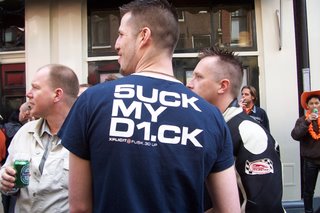
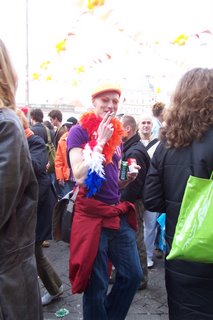
In a mean time, a big flock of male gathered and made their own group. Noticing their custom and their gesture, apparently people would be absolutely sure they were a bunch of gay people. They were dancing under a stage bridging two buildings on Reguliersdwarsstraat following the rhythm of techno music. There were banners naming a gay magazine with a picture of semi nude six-packed young men. Free brochures of up-coming gay events were handed out and spread to the crowd by gay bars workers. Some gay couples hugged and kissed each other. Those who met new friends or addressed old colleagues initially traded furtive mouth kiss. They did not feel bothered by a few hetero couples joining the triumph of the glee. In attire few people of that minority group were also distinguishing. They were so dare to wear unusual clothing that people would stare and take a look at them and understand they were queers. It would be obvious if there are three guys, one of them in tight t-shirt with big capital letter written “SUCK MY DICK” at the back kissing his friends' ears. A guy wearing a fur with rouge lipstick color and long orange artificial eyelids merely cheered the gangs. Or a man in his late thirties was dressed up in a monarchial queen style plus a queen-make-up look, unsuccessfully hiding he was a queer.
Yup, there they go! Queen's day is a happy day for everyone but for the queers in liberal Amsterdam, indeed it is a defining day of their existence.
Photos; Yuhendra
You can also visit this story and other queen's day story in http://www.journalism.fcj.hvu.nl/index.php?id=5507

Tuesday, May 09, 2006

Wageningen VS Amsterdam; Green City VS Concreted City


Yuhendra

It is always fascinating to travel around a small city to see natural picturesque, quiet life, to feel fresh air and smell farming scent. Yet, it is also interesting to wander around a big city for up-to date things, window shopping, and meeting busy people. To experience these different trips in the Netherlands, Wageningen and Amsterdam could be appealing alternatives. They offer real comparison between green town VS concreted city. Both places are only around 25 minute trips from Utrecht.

Leaving for Wageningen from Utrecht by train is like a trip from almost-big city to small one. As the train moves leaving Utrecht, you can catch the picture of typically Dutch brick houses and buildings which gradually change into green field with sheep and isolated houses after a fifteen-minute trip. Later when you get off the train you will feel that you are in a real Dutch Village. Not many people rush for tickets neither in the train station nor in the bus station as normally seen in Utrecht.

The buses are not triple-bodied as usually found in Utrecht because they only serve few people. Neither there are not many cars on the street nor there many the bikers. It is not the quietness gives a remarkable experience but the atmosphere it got. Old buildings are easily found. The river, green fields bordered by trees which are now unfortunately leafless for the winter, and the scent of farming sheep bring in the feeling that you are now in the village. It's so natural! That makes sense this city is called City of Life Science, particularly for agriculture research.

The people do not seem under time-pressure so that they sincerely observe rules and norms. Take pedestrians for instance, even though there is no car or probably cars will not be passing within three minutes on the street while the red light is on, they will keep waiting until the light turns green. Or the bikers for example, using a light while riding is a must in the evening even though you are sure there is no police around. Besides, warm greetings are still heard frequently, no matter if you are a stranger. It shows a genuine typically Dutch. The combination of uniquely picturesque and pleasant social life constitutes Wageningen as a good alternative for weekend. It can be explored by car, by bike or on foot.

"This is a peaceful place that I most love in the Netherland. I want it keep this way. I don't want it turn into a big city where many cars, busy people and modern building are put into one together," said Loryn van Rooyen, a student who is originally from Wageningen.

It is not that she is afraid of change but she cherishes the value of humanity which she considers will influence her beloved hometown. Even though Wageningen has not had big transformations yet she finds that Wageningen is not the same as the place she used to live in during her childhood.

"Nowadays, I do not feel ok to walk out alone in the evening. The imaginations of crimes threaten me. But, well, anyhow, this is still the better place to live," she conveyed her feelings.

Loryn may say Wageningen is a good place for her to live. But Amanda, also a student, prefers to live in big a city like Amsterdam. "I can find a lot of things here, many people of different races, facilities, access to entertainment and many more. You just name it," she told enthusiastically.
Unlike Wageningen, Amsterdam accommodates people with a range of facilities. You can easily find places for pleasure, free markets for souvenirs, transportation; buses, trams, taxies for wandering around, malls for shopping, museums, theatres and anything else.

This atmosphere of modernity can be felt right after ten minutes before the train stop in the station. An approximate 25-minute-trip from Utrecht to Amsterdam represents a time warp, from almost -big city to the big one.

As the train starts moving from Utrecht central station, you will see the combination of bricked houses, modern office and apartment buildings side by side. The view gradually changes into a more crowded place with densely packaged modern buildings after 20 minutes. Small brick houses are hardly found and replaced by high apartment buildings and sky crappers. There are a lot of cars on the street as well as bikers and pedestrians which make you aware that you are now in metropolitan area.

Visiting Amsterdam means visiting two different zones; "bad and good" for tourists. You can wander the good zone to see museums, go shopping, and go hunting the free market while in bad zone you can find red light girls, sex shops, sex bars and other sexual services. It is truly an accumulated urban are in the Netherlands so that you can not expect to see green field in it.

Everywhere you turn and walk you will see a lot of people. Visitors enjoy the window shopping while the inhabitants are in a rush for work. Red light is no longer taken into account. As long as cars, buses, or trams are not really close, people pass the street. In such conditions, you do not need to expect warm greetings. Greetings are exchanged only when you are dealing to buy something.

One remarkable thing which makes Amsterdam different from modern urban is the existence of old historical buildings. In Amsterdam such buildings are used not only for museum but also for malls. It makes Amsterdam both modern and classy which is worth an extended visit.

Photo by; yuhendra

What's in Dutch's Name?

Yuhendra
Having a single name has never been as complicated as I thought after my coming in Holland. When I began dealing with filling-in-forms bureaucracy, I had to be ready with the same some answers; "It is a normal way for Indonesian parents in naming their children by one name", eventhough I know it doesn't answer their curiosity. And yet, it is still not as easy as such answer for I have to agree to the system by which the Dutch are named. Once I went to a bank to open my bank account, I had to say "yes" when the bank staff put initial "Y" in front of my name, with one simply reason, the computer was programized for Dutch name system which consists two names; first name and family name.

Talking about the Dutch's name would have never been interesting to me if an International Office staff didn't tell me that Dutch name has its own history. The way Dutch gives name has begun since early 18th century. They have voornaam for first name and achternaam for last name or family name.

Despite the history, I found Dutch name is quiet unique (to avoid the word funny) meaning. I don't mean to make a mock or payback because they consider I have strange name, but anyway it remains intriguing for me to know more about their names. Take for an example; Hans van Amsterdam which means Hans who is originally from Amsterdam. He probably got the name because his ancestors moved from Amsterdam to other cities and consider the name of his hometown would probably good and distinguishing for being a name. Well, such a name could still be accepted for me. But, there is a hilarious achternaam; naahtgeboren which means you were naked when you were born. Of course everybody is naked when they are born, aren't they? There are also some last names which force me to smile. There are also names Doosje which means box, or schoen which means shoes, or Potlood which means pencil. I can hardly think what my name would sound like if there is a pencil after it. "Yuhendra Pencil" that must be a great joke for my friends.

So, if Shakespeare onced asked "what's in a name?" Dutch must have perfect answers. They got some tools in their names. Anyhow, it is great to have meaning in their names, while I don't have any.


Photo by; yuhendra

Discovering the Glorious past of Indonesia


Yuhendra

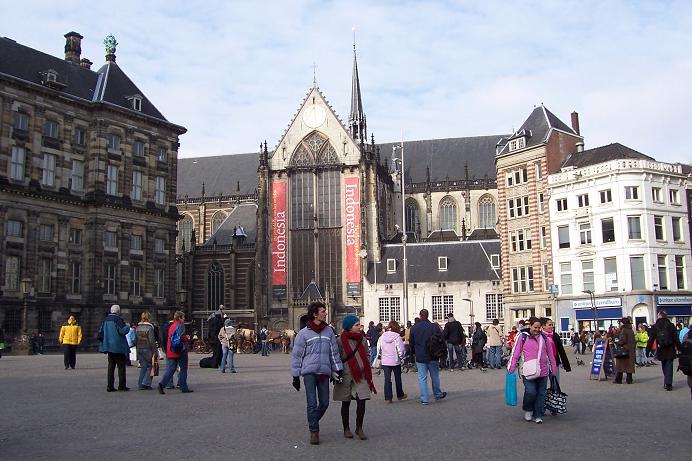
The exhibition INDONESIA: the discovery of the past is now on show in De Nieuwe Kerk, Amsterdam from 17 December 2005 until 17 April 2006. It presents more than 300 masterpiece collections of the Museum Nasional Indonesia in Jakarta and the Rijksmuseum voor Volkenkunde (National Museum of Ethnology) in Leiden. On display there are six large sculptures from the Singasari period (13th century), magnificent gold handmade ornaments and palace treasures from Sulawesi, Lombok and Bali, as well as rare ethnographical from West and East Indonesia, including New Guinea which most of them had never been displayed before.

Regarding the theme, the exhibition is not only displaying a long adventure of the two museums in collecting past treasures of Indonesia or recent discovered gold treasures but also showing Indonesia's greatness Art during thirteenth century. The collection of gold, silver and other jewelries, Buddha statues, sculptures, keris (daggers) and wayang puppets prove that old emperors in Indonesia contributed significant influence in Art.

Take the magnificent Prajnaparamita statue for instance (figure at the left). It was sculptured in Singasari, Java, in thirteenth century. This 126 cm stone statue reflects the Goddess of Transcendental Wisdom sitting on the lotus position. Her hands gestures the symbol of the Wheel of the Law. Her serene expression is extremely contrasted to her richly decorated appearance. Prajnaparamita was also called Princess Dedes by Javanese. What is more, Princess Dedes was strongly believed as a daughter of Buddhist.

Despite the vagueness between Prajnaparamita as a goddess and Princess Dedes as a first queen of Singasari, this statue shows its significance. Her dignified status can be seen from her adorable crown, jewelry; armlets, a caste cord, armlets, bracelets, finger and toe rings. Princess Dedes was carved in a good anatomy with slim shape and firm breasts. By capturing her carved beauty it makes sense that she was well-known as a queen from whom all kings of Singasari and Majapahit descended.

Anyway, her deep relaxed look reminds us to the head image of Indian savior, Buddha which was made around third century AD. The beautiful head of the Budha with its expression of deep repose was made in frontier region of Gandhara, Northern India, (Gombrich, H.E. The Story of Art, World Conquerors, Oxford, Phaidon, 1989)

The other extremely collection is Garment from Mandailing clan, North Sumatra. The result of expedition to Central Sumatra is a discovery of 60 cm width garment which was made on cotton and mica with gold thread.

This magnificent hand garment is presumed has existed during the Dutch colonial time in Indonesia 1800 (figure at the right). Mandailing is the name of one clan in North Sumatra. Before the coming if Islam (1820) the people were animism believers. It seems that Islam had also influenced their lacework.

As Gombrich explains in his book The Story of Art, Looking Eastwards, in Islam the making of images was forbidden. As the consequence they let their imagination play with patterns and forms and create the most subtle lacework ornamentation known as arabesques. In second to thirteenth century, outside the Islamic dominions the world became familiar with inventions through Oriental rugs. The Mandailing garment could be compared to Persian carpet which was made about 1600. The artist plays with their dream world of lines and colors.

Other proofs of the past gloriousness of Indonesia can also be seen through other luxurious displayed collections. They tell about Indonesian Art in Hindu-Buddhist time and in the period of the coming of Islam. There are bronze sculptures; Statue of Padmapani/ Avalokiteshvara Borobudur, (Java, 8-9th century, Height: 15.4 cm), Figure of a ram from East Java, (14-15th century, Height: 11.5 cm) which was fashioned according to the lost wax method. Height: 11.5 cm. There also golden and silvery marvelous jewelries like Bracelet, Ponto Sipappa made of silver, golf leaf, gemstones from Gowa, Sulawesi which was Presented to Rijks Ethnografisch Museum by the Crown Prince of Gowa (1890), crown made of gold, gemstones, rubies and cane, and ethnical handmade earrings and gold hair ornament. Some historically splendid stone statues are also shown, like Ganesha, the elephant god in Singasari period, (Java, 13th century) with height: 154 cm, or 106 cm-height Buddha Amitabha, which is origin: from Borobudur temple,(Java 8/9th century).

Photo from Museum Nasional Indonesia